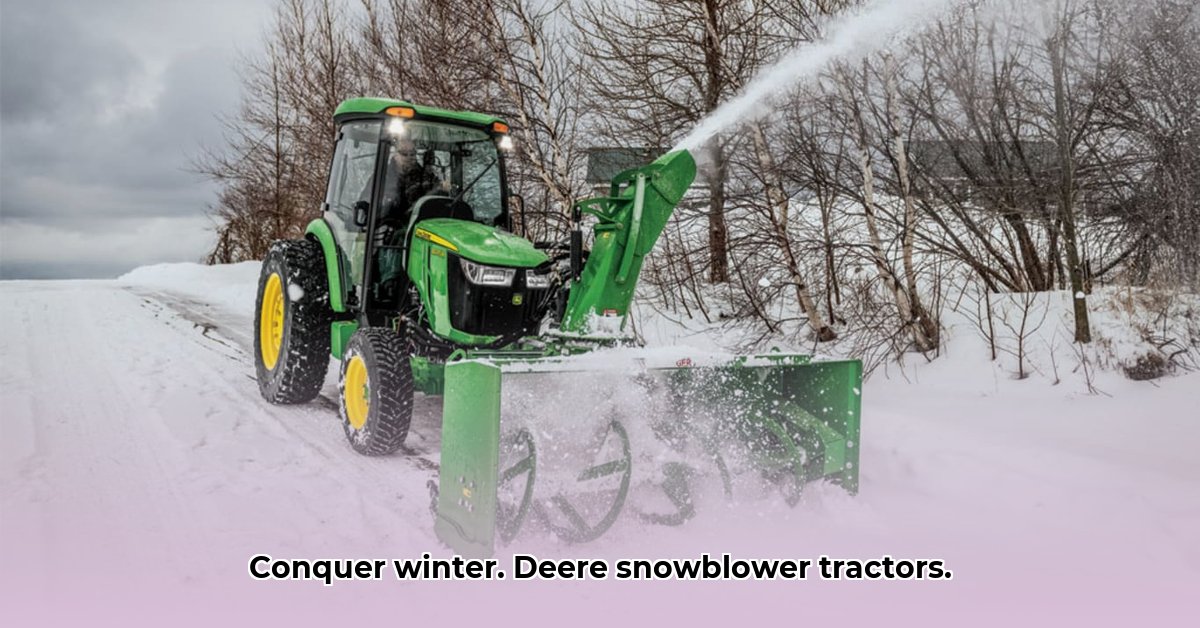
Snowblower Tractors: Conquering Winter's White Menace
John Deere snowblower tractors offer powerful snow removal solutions for farms, transforming the fight against winter's fury. These aren't your average snow throwers; they're robust machines built to handle significant snowfall, ensuring farm operations continue even during severe blizzards. This guide explores the selection, operation, maintenance, and sustainability aspects of Deere snowblower tractors. For more in-depth information, check out this helpful resource.
Deere's Snow-Fighting Arsenal: Attachments for Every Situation
John Deere provides a range of snowblower attachments, including front-mounted and rear-mounted options. These heavy-duty attachments feature cast iron gearboxes and resilient augers capable of clearing large volumes of snow. Quick-hitch systems facilitate easy attachment changes, maximizing efficiency. Adjustable chutes offer precise control over snow dispersal. Choosing the right attachment is critical for effective snow removal.
Picking the Perfect Snowblower: Matching the Machine to the Mission
Selecting the appropriate snowblower hinges on various factors. A small blower suffices for driveways or walkways, while larger, heavy-duty models are necessary for extensive farmlands or commercial properties. Consider typical snowfall amounts, tractor size, and the scale of the area needing clearance. A compact tractor cannot handle a massive snowblower; compatibility is crucial.
Beyond Brawn: Sustainability and Smart Technology
While current Deere models utilize traditional fuels, the emphasis on sustainability is growing. Future innovations likely include electric or hybrid systems, promising substantial fuel cost savings and reduced emissions. Deere's integration of smart technology, such as sensors to optimize snow removal, enhances fuel efficiency and minimizes environmental impact. The long-term vision is a significant reduction in fossil fuel dependency.
Did you know that efficient snow removal practices can significantly reduce fuel consumption by approximately 15-20%? This simple operational change can lead to significant savings over a winter season.
Operation and Maintenance: Safety First, Always
Safe and effective snow removal necessitates adherence to manufacturer instructions. Regular maintenance is key; neglecting this aspect can lead to costly repairs and equipment failure. Preventive maintenance, including inspecting and replacing worn parts like shear bolts and lubricating driveshafts, ensures smooth operation and extends the lifespan of your equipment. "Regular maintenance is as crucial as the tractor itself," says Dr. Emily Carter, Agricultural Engineering Professor at Purdue University.
Spotting Potential Problems: A Risk Assessment Snapshot
Even robust equipment can experience issues. Proactive identification and prevention are crucial.
| Component | Likelihood of Failure | Severity of Problem | Prevention |
|---|---|---|---|
| Cast iron gearbox | Low | Moderate | Regular inspections, maintenance |
| Hydraulic chute control | Moderate | High | Regular checks, prompt repairs |
| Auger shear bolts | Moderate | Low | Regular inspections, replacements |
| Telescoping driveshaft | Low | Moderate | Lubrication, visual inspection |
| Tractor's 3-point hitch | Low | Moderate | Proper installation, checks |
How to Compare Fuel Efficiency of Deere Compact Tractor Snow Removal Attachments
Choosing the right snow removal attachment significantly impacts fuel consumption and environmental impact. Different attachments (rotary brooms, front blades, snow pushers, snowblowers) have varying levels of fuel efficiency, influenced by snow conditions and acreage. Maximizing efficiency and minimizing environmental impact requires a clear understanding of these factors.
Key Takeaways:
- Attachment choice drastically affects fuel usage and environmental impact.
- Different attachments exhibit varying fuel efficiencies.
- Snow conditions and acreage significantly influence fuel consumption.
- Efficient operation is paramount for minimizing environmental impact.
- Long-term sustainability necessitates considering fuel efficiency alongside other factors.
Understanding Fuel Efficiency in Snow Removal
Efficient snow clearance is crucial during winter. For John Deere compact tractor owners, selecting the proper attachment is paramount. Factors influencing fuel consumption include attachment type, snow conditions, ground conditions, ground speed, tractor size and engine, and operator technique.
Factors Affecting Fuel Consumption
- Attachment Type: Rotary snow blowers generally consume more fuel than snow blades due to higher power demands.
- Snow Conditions: Wet, heavy snow requires more power than light, powdery snow.
- Ground Conditions: Hard-packed snow or ice increases fuel consumption.
- Ground Speed: Finding the optimal balance between speed and fuel efficiency is vital.
- Tractor Size and Engine: Larger tractors with more powerful engines consume more fuel but clear larger areas quicker.
- Operator Technique: Smooth operation and avoidance of unnecessary idling save fuel.
Comparing Fuel Efficiency: A Practical Approach
Direct fuel efficiency comparisons of attachments are often unavailable publicly. A practical, multi-step approach is necessary:
- Assess Needs: Evaluate snowfall amounts and the area requiring clearance.
- Consult Dealers: Seek advice and anecdotal evidence from local John Deere dealers.
- Consider Operational Time: Estimate the time each attachment would require for snow removal.
- Monitor Fuel Usage: Track fuel consumption under similar weather conditions during testing.
Long-Term Sustainability
Fuel efficiency is vital, but long-term sustainability also encompasses attachment lifespan, maintenance practices, and the overall environmental impact beyond fuel consumption (noise pollution, soil compaction). Prioritizing these factors contributes to environmentally responsible snow removal practices.
The Future of Snow Removal: A Look Ahead
The agricultural landscape is evolving; snow removal is no exception. Increased focus on eco-friendly practices necessitates adaptations in snowblower tractors. Future developments will likely include improved fuel efficiency, alternative power sources, and advanced technologies including autonomous operation. Government incentives and ongoing research and development will shape the future of sustainable snow removal.